



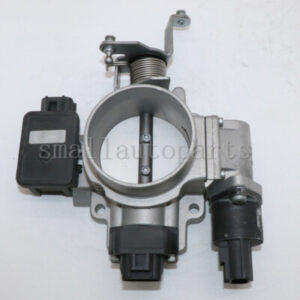
Throttle Body VP4F9U-9E928-AC for Ford Focus II
This throttle body assembly is engineered as a direct replacement for the Ford Focus II. Manufactured to meet or exceed OEM specifications, it delivers reliable performance in demanding conditions. Each unit is tested for fuel flow, pressure rating, and durability before leaving the factory to ensure consistent quality across every order.
Vehicle Compatibility
| Application | Details |
|---|---|
| Ford Focus II Part Number:VP4F9U | 9E928-AC Applications |
| Ford Focus IIFor | See product specifications |
| Ford Mondeo 2.3L 2.5LFor 2009 | 2011 Mercury Mariner with production dates after 6/22/08 and with 2.5L gas/electric engine, 2.5L DOHC 4 cylinder gas engine, and 3.0L OHV V6 engine.For 2009-2011 |
| Ford Escape Hybrid with production dates after 6/22/08 and with 2.5L gas/electric engine, 2.5L DOHC 4 cylinder gas engine, and 3.0L OHV V6 engine.For 2009 | 2011 |
| Ford Fusion with production dates after 2/3/09, with 2.5L gas/electric engine, 2.5L DOHC gas engine, and 3.0L 4VOHC V6 | See product specifications |
Replaces OEM Part Numbers
VP4F9U-9E928-AC • 2009-2011
Signs You Need a Replacement
If your equipment is showing any of these symptoms, the throttle body may be the cause:
- Surging or fluctuating idle speed — The throttle plate or motor is sticking, causing the ECU to hunt for the correct idle position. This is the most common early symptom.
- Reduced throttle response — A dirty or worn throttle body doesn’t open smoothly. You’ll notice a dead spot or hesitation when you press the pedal.
- Check engine light with P0121 or P1545 — These codes indicate a throttle position correlation error. If cleaning doesn’t clear them, the throttle body needs replacement.
- Limp mode activation — The ECU limits engine speed when it can’t trust the throttle position signal. This safety mode prevents damage but limits operation.
- High idle that won’t come down — Carbon buildup holds the throttle plate slightly open. The ECU compensates by raising fuel trim, which may trigger adaptive mixture codes.
- Stalling at low RPM — When the throttle body can’t maintain a stable idle, the engine may stall at stoplights or when shifting from drive to reverse.
Post-Installation Adaptation
After installing the new throttle body, perform a throttle adaptation so the ECU learns the new zero and full-throttle positions. With VCDS or equivalent: go to Engine, Basic Settings, channel 060 or 098 (varies by ECU), and follow the on-screen prompts. Without a diagnostic tool, use the manual method: turn the key ON (engine off) for 60 seconds, then OFF for 10 seconds. Start the engine and let it idle for 3 minutes without touching the accelerator. Do not rev the engine during this process.
Frequently Asked Questions
Which Ford models does this part fit?
Refer to the Vehicle Compatibility table above for the full list of Ford models. Each listing includes the body type, engine, and production years. Match your vehicle’s engine code (stamped on the engine block) against the listed codes to confirm.
Can I cross-reference VP4F9U-9E928-AC with 2009-2011?
Yes. Both VP4F9U-9E928-AC and 2009-2011 are interchangeable OEM numbers for this part. They refer to the same component with the same specifications, just different part number revisions.
My vehicle is a 2009 model – is it covered?
The compatibility range for this part includes 2009-2011. The 2009 model year falls within this range, but verify the engine code and body type match. Mid-year production changes sometimes mean two vehicles from the same model year use different parts.
Do I need to do a throttle adaptation after installing this?
Yes. After installing the new throttle body, run a throttle adaptation (basic setting) so the ECU learns the new zero and full-throttle positions. With VCDS: Engine, Basic Settings, Group 060 or 098. Without a diagnostic tool: key ON for 60 seconds, OFF for 10 seconds, then start and idle for 3 minutes without touching the gas pedal.


Reviews
There are no reviews yet.